


Developing frontiers, brighter tomorrow
 The main point of this article is to review an important paper recently published by Fred Hutchinson Cancer Center (“Hutch”) researchers in “Blood” titled “Who is fit for allogeneic transplantation?” As the premier stem cell transplant center in the USA (and perhaps the world), when the Hutch speaks, physicians and patients listen.
Stem cell transplant technology is a rapidly developing field. The good news is that survival statistics and cure rates are increasing slowly but surely, year by year. The bad news is that as with most cutting edge technology, there is a bewildering thicket of jargon and acronyms that patients have to wade through before they can come up the learning curve. I can’t do much about the survival statistics besides report them. But I can try to make the jargon and acronyms less intimidating. Before we get to the main course, please bear with me while I give a quick cheat-sheet for the newly diagnosed members in our community.
Cheat Sheet: what is a “mini-allo stem cell transplant”?
Let us take the two most important words in that phrase, “stem cells”. If you were a stickler for total accuracy you would say “hematopoietic stem cells”. You see, we are not talking about the real grand-daddies (and grand-mommies) of all stem cells, the embryonic stem cells created when a human egg is fertilized by human sperm. Embryonic stem cells can grow, specialize, divide, and when everything is working just right, eventually make a complete human baby. Embryonic stem cells are the ultimate jacks of all trades, they can do the whole gamut of tasks needed to make a very complex human being.
As embryonic stem cells go about doing their job, some of them make an irrevocable decision to change into more specialized kinds of stem cells. One of the many kinds of specialized stem cells are hematopoietic stem cells (HSC). These blood stem cells (hematopoietic = blood) are able to do only one thing. They can make all the different varieties of cells present in your blood. HSC can make red blood cells, platelets, lymphocytes, macrophages etc. But that is all they do, they make blood. HSC cannot make babies.
HSC needed for transplants are obtained from two sources and only these two sources (1) willing and healthy adult donors who are doing it for no other reason than generosity and desire to save lives (2) Umbilical cord-blood, a “waste” product that is generally thrown away after a baby is born. Fortunately for us, this means there are no political or ethical controversies out there surrounding research having to do with HSC transplantation.
In contrast to allogeneic hematopoietic stem cell transplants , autologous stem cell transplants involve harvesting the patient’s own stem cells first, then treating the patient with very heavy dose chemotherapy, followed by giving him back his own stem cells. Auto stem cell transplants are no longer recommended for CLL patients (except under special circumstances) since they are not able to cure even a percentage of patients undergoing them.
Earlier in the development of stem cell transplants, patients went through full strength “myeloablative” pre-conditioning prior to receiving the precious healthy stem cells from their donor. This pre-conditioning generally involved chemotherapy plus high dose full body radiation. The idea was to kill off the patient’s own immune system thoroughly, as well as do a thorough job of killing as many cancer cells as possible, before introducing the new donated immune system. Good idea, except that the process of myeloablative conditioning was very hard to tolerate. Only quite young and fit patients could hope to tolerate full strength myeloablative conditioning, and even then the mortality was quite high. This was a case of transplant perhaps curing the original cancer, but killing the patient as well in the process – death by therapy.
We now have non-myeloablative pre-conditioning. It still uses massive amounts of chemotherapy, and many institutions still use low dose radiation as part of the protocol. But it is nowhere as high impact as earlier myeloablative procedures. The result has been that older patients are now eligible for transplantation, as well as those who are not quite marvels of good health and fitness. The word “mini” (as opposed to “maxi”, I suppose) is just a catch word to describe the fact that the pre-conditioning is not quite as tough as it used to be. But don’t make the mistake of thinking mini-allo transplants as the equivalent of a friendly walk in the park. They are still pretty daunting procedures, there is still mortality and morbidity, people still die from therapy related causes, some people still relapse with their original cancer. But there is also no question that things are getting better, older patients can benefit, survival statistics are improving and there is every reason to hope this trend will continue.
“Who is Fit for Allogeneic Transplantation?”
The abstract of this important paper published in August edition of “Blood” is given below. If you are ever likely to be in the market for a transplant, this is a must read paper. Send me a personal email if you want to read the full text article and I will try and point you in the right direction.
Blood. 2010 Aug 11.
Who is fit for allogeneic transplantation?
Deeg HJ, Sandmaier BM.
Fred Hutchinson Cancer Research Center and the University of Washington School of Medicine, Seattle, WA, United States.The use of allogeneic hematopoietic cell transplantation (HCT) has expanded progressively, facilitated by the increasing availability of unrelated donors and cord blood, and the inclusion of older patients as transplant candidates. Indications remain diagnosis-dependent. As novel non-transplant modalities have been developed concurrently, many patients come to HCT only when no longer responding to such therapy. However, patients with refractory or advanced disease frequently relapse after HCT, even with high-dose conditioning, and more so with reduced-intensity regimens as used for patients of older age or with co-morbid conditions. Thus, patients with high-risk malignancies who have substantial co-morbidities or are of advanced age, are at high risk of both relapse and non-relapse mortality, and should probably not be transplanted. Being in remission or at least having shown responsiveness to pre-HCT therapy, is generally associated with increased transplant success. In addition, to handle the stress associated with HCT, patients need a good social support system, and a secure financial net. They need to be well informed, not only about the transplant process, but also about expected or potential post-HCT events, including graft versus host disease and delayed effects that may become manifest only years after HCT.
PMID: 20702782
What makes for a good risk transplant candidate?
Here is how the Hutch defined good risk and poor risk candidates for hematopoietic stem cell transplants.
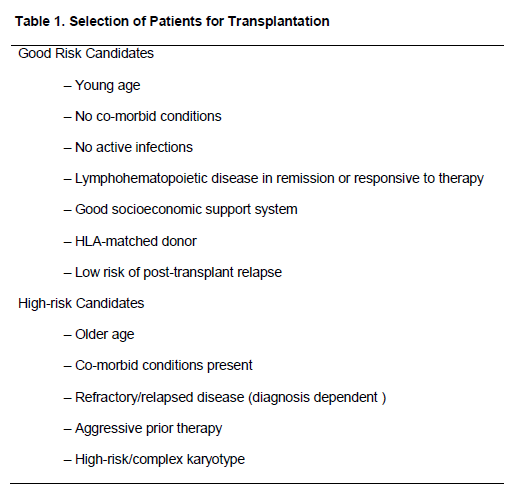
This paper does a good job of examining each of these criteria in detail and how they impact stem cell transplant success. Please remember Hutch is not talking about just CLL cases in this paper. The discussion is more general and includes all the various types of blood cancers. This is something you should keep in mind as you read the full text article.
Younger, healthier patients who have no other medical problems will do better. Switching from full strength myeloablative transplants to “kinder and gentler” mini-allo transplants has meant that patients well into their seventies can now be eligible for transplantation. Age at transplant time has been going up every year. Over the last ten years, one in every five transplant patients is in his/her 7th or 8th decade of life.
But the other side of the coin is that waiting until the bitter last moment (either in terms of age or disease progression or general overall health) may make the whole transplant decision moot, irrelevant. So, besides the “who” part of the question, here is the million dollar question: when is it the right time to opt for a mini-allo transplant? One again we face the Goldilocks’ dilemma. We don’t want to do it too early in the game, but we don’t want to wait too long either. We explored this search for the perfect decision time in an earlier article titled “Catch 22”. The Hutch criteria reinforce the decision points. Consider a transplant before your CLL becomes truly refractory, before it grows fangs and starts “ROFL” (laughing) at standard chemotherapy. Do it while you are still in relative good health.
Since mini-allo transplants depend upon “graft-versus-leukemia” (GVL) effect to track down and kill the remaining CLL stragglers in your body after the transplant, it makes sense that patients with very low levels of cancer cells in their body just ahead of the transplant will fare much better. The idea is to go into a transplant while still in a very deep remission, with no more than trace amounts of CLL cells that need to be tackled by the curative action of GVL. Relapse rates (return of the CLL even after transplant) are very much dependent on the level of remission prior to transplant and whether or not the patient’s cancer was still response to chemotherapy. Waiting too long can quickly become a sucker’s game.
Finding the right donor
It is very important to have a well matched donor. That is sort of the ante you have to have before you get in the transplant game. The first choice is to look at your own brothers and sisters. A well matched sibling donor is still the best choice. Next best choice is unrelated but well matched adult donors from the stem cell donor banks around the world. Tough luck on this one if you are an ethnic minority; your chances of finding an adult donor in the donor banks is much poorer if you are of mixed ethnicity or your particular brand of ethnicity is not well represented in the donor banks. The next choice is stem cells from umbilical cord blood. This opton has rapidly become a life line to patients who need a transplant and do not have sibling or unrelated matched adult donors.
There were more than 26,000 hematopoietic stem cell transplants worldwide last year. 6,500 of them were done in Northern America. People ask me why there are “only” six or seven thousand hematopoietic stem cell transplants in North America. A major stumbling block to stem cell transplants is the ability to find a suitable stem cell donor. Large families with many brothers and sisters are no longer the norm, sibling donors are much harder to find today. We are a melting pot here in America, representing just about every ethnic minority there is in the face of the world. Since transplant candidates are getting older on average, their brothers and sisters are getting older too – possibly with health conditions themselves that prevent them from being good donors for their CLL sibling.
We desperately need better funded stem cell donor banks. We also need a motivated and determined cadre of advocates to drive stem cell donor registration, especially in minority populations. Cord blood banks are such a “gimme” that it breaks my heart how little they are used in this country. Rather than throwing the umbilical cord into the trash after the baby is born, or letting unscrupulous hucksters con you into saving the cord “for your own use” in private banks, each and every healthy baby born to a healthy mother should be blessed with the good karma of possibly saving a life – by donating the baby’s umbilical cord to the voluntary cord blood donor banks.
Non-medical criteria
This is the first time I have seen doctors go beyond the medical requirements and address financial and social support systems in their analysis. As you can imagine, discussions of money, social and cultural background, race, haves and have-nots etc. are incredibly sensitive and divisive in the political environment of today. We steer clear of politics on this website. I ask you to do the same. Just consider this: CLL is a non-discriminatory cancer. It really does not care about all these differences that separate us. Take away the unimportant details and we are all brothers and sisters fighting a common enemy. That is all I care about. I hope you do too.
Getting a successful transplant depends on many factors, not just medical factors. Do you have good medical insurance? Transplants are expensive business. They can cost anywhere from several hundred thousand dollars for a straightforward and no complication transplant to a couple of million dollars for a complicated case needing lots of hospitalization etc. Is your insurance up to the challenge? I am no expert on insurance and Medicare issues – but I do know they play a huge role in the lottery of life that our guys face.
How about family and care givers? Transplant patients need 24/7 devoted caregivers for several months after completion of the transplant. I know, I was there. Taking care of my husband PC while he was going through his (cord blood) stem cell transplant was no easy matter for me and our daughter. Here is where the investments made in developing strong family ties and community support will help the patient, big time.
Are you fighting a multi-front war with cancer as only one of a set of medical problems? Older patients are more likely to have co-morbidities such as cardiac and pulmonary issues, diabetes, high blood pressure. Last but not least, how is your emotional stability and intestinal fortitude? Do you still have the cojones to handle the emotional and physical roller-coaster that a transplant can be? Only you can answer that question.
Impact of prognostics on transplant decisions
The Hutch paper does not discuss the specifics of CLL prognostics and how they impact transplant decisions. But an earlier very important European consensus document addressed that particular question. CLL is an indolent disease. In a significant lucky minority, the disease “smolders” and goes no where fast. It would be a terrible mistake to put these people through the risk and dangers of stem cell transplants.
But not everyone is so lucky. There are patients whose CLL gallops ahead from day one, who burn through every chemotherapy option there is and face grim prognosis. The good news is that with modern prognostic indicators we have a chance of identifying these people ahead of time. They are good candidates to get into a transplant program sooner rather than later. They may not get too many good remissions and should be aware that putting off transplant decision may close the window of opportunity for them. This is particularly true of younger patients with aggressive disease. They do not have the luxury of running out the clock. For them CLL is very much a killer cancer – where the only cure is a mini-allo stem cell transplant.
As we adopt ever more aggressive therapy options as frontline gold standards, choices remaining to patients who relapse after these chemoimmunotherapy options are not all that good. Some of these issues were discussed in our article “Life after FCR“. Only patients who did well after FCR relapse are those that chose transplant as their choice of salvage therapy.
Leukemia. 2007 Jan;21(1):12-7.
Indications for allogeneic stem cell transplantation in chronic lymphocytic leukemia: the EBMT transplant consensus.
Dreger P, Corradini P, Kimby E, Michallet M, Milligan D, Schetelig J, Wiktor-Jedrzejczak W, Niederwieser D, Hallek M, Montserrat E
Chronic Leukemia Working Party of the EBMT.
Department of Medicine V, University of Heidelberg, Heidelberg, GermanyThe aim of this project was to identify situations where allogeneic stem cell transplantation (allo-SCT) might be considered as a preferred treatment option for patients with B-cell chronic lymphocytic leukemia (CLL). Based on a MEDLINE search and additional sources, a consented proposal was drafted, refined and approved upon final discussion by an international expert panel. Key elements of the consensus are (1) allo-SCT is a procedure with evidence-based efficacy in poor-risk CLL; (2) although definition of ‘poor-risk CLL’ requires further investigation, allo-SCT is a reasonable treatment option for younger patients with (i) non-response or early relapse (within 12 months) after purine analogues, (ii) relapse within 24 months after having achieved a response with purine-analogue-based combination therapy or autologous transplantation, and (iii) patients with p53 abnormalities requiring treatment; and (3) optimum transplant strategies may vary according to distinct clinical situations and should be defined in prospective trials. This is the first attempt to define standard indications for allo-SCT in CLL. Nevertheless, whenever possible, allo-SCT should be performed within disease-specific prospective clinical protocols in order to continuously refine transplant indications according to new developments in risk assessment and treatment of CLL.
PMID: 17109028
Results
This Hutch article is not restricted to CLL; it considers all the major blood cancers. Please keep this in mind as you read the full text article. But one telling paragraph about CLL response statistics caught my eye.
- In CLL patients undergoing stem cell transplants after relapsing from fludarabine and cyclophosphamide containing regimens, Hutch projects 60% of the patients achieved “progression free survival”. What does that mean? 60% of the patients lived, without relapse of their CLL. I don’t know about you, I call that a CURE.
- Patients going into the transplant with bulky disease had higher risk of their CLL coming back even after the transplant. Moral of the story, be kind to your new immune system, try and not ask it to lift too heavy a burden right away. Going into the transplant with lower level of CLL cells still lurking around gives the Graft versus leukemia effect a chance to succeed. You do not want to be in an out-gunned and out-numbered armies situation here.
These statistics look backwards, results obtained over the last decade or so. Technology has not stopped moving forward. Each month I read new reports, new transplant procedures explored to minimize pesky graft-versus-host disease (where the new graft attacks its host, namely the patient) while increasing the oomph of life saving graft-versus-leukemia.
Transplant technology is not quite a cut-and dry technical procedure. There is a lot of room for expertise and that makes it all the more important to make your transplant center and transplant team choices with care. Below is a very recent example of what I am talking about. In this clinical trial using a novel transplant approach, the overall progression free survival rate at 4 years was 76%. But if we look at only those patients who had sibling donors, the progression free survival was a whopping, wonderful 90%. How do you like them apples? Hunh? True, these are not CLL patients, but they are follicular lymphoma (non-Hodgekin’s lymphoma) patients – kissing cousins as it were. I will be happy to review this particular article if enough of you are interested.
J Clin Oncol. 2010 Aug 10;28(23):3695-700.
T-cell-depleted reduced-intensity transplantation followed by donor leukocyte infusions to promote graft-versus-lymphoma activity results in excellent long-term survival in patients with multiply relapsed follicular lymphoma.
Thomson KJ, Morris EC, Milligan D, Parker AN, Hunter AE, Cook G, Bloor AJ, Clark F, Kazmi M, Linch DC, Chakraverty R, Peggs KS, Mackinnon S.
Department of Haematology, University College Hospital, London, UK. Kirsty.thomson@uclh.nhs.ukPURPOSE: Follicular lymphoma (FL) is an indolent disorder that is treatable but considered incurable with chemotherapy alone. The curative potential of allogeneic transplantation using conventional myeloablative conditioning has been demonstrated, but this approach is precluded in the majority of patients with FL because of excessive toxicity. Thus, reduced-intensity conditioning regimens are being explored.
PATIENTS AND METHODS: This study reports the outcome of 82 consecutive patients with FL who underwent transplantation using fludarabine, melphalan, and alemtuzumab for in vivo T-cell depletion. Patients were heavily pretreated, having received a median of four lines of prior therapy, and 26% had experienced treatment failure with previous autologous transplantation. Median patient age was 45 years, and 52% of patients received stem cells from unrelated donors.
RESULTS: With a median follow-up time of 43 months, the nonrelapse mortality was 15% at 4 years (8% for sibling and 22% for unrelated donor transplantations), acute grade 2 or 3 graft-versus-host disease (GVHD) occurred in 13%, and the incidence of extensive chronic GVHD was only 18%. Although relapse risk was 26%, this was significantly reduced where mixed chimerism had been converted to full donor chimerism by the use of donor lymphocyte infusion (DLI; P = .03). In addition, 10 (77%) of 13 patients given DLI for relapse after transplantation experienced remission, with nine of these responses being sustained. Current progression-free survival at 4 years was 76% for the whole cohort (90% for those with sibling donors and 64% for those with unrelated donors).
CONCLUSION: The excellent long-term survival with associated low rates of GVHD and the frequency and durability of DLI responses make this an extremely encouraging strategy for the treatment and potential cure of FL.
PMID: 20606089
Coming up the learning curve
Below are several articles from our archives. I strongly urge you to read these and other sources before you make transplant decisions. This is not an easy process, either in terms of money or risk. I am not exaggerating when I say your life hangs in the balance. You can search PubMed for related articles and read the original research publications for yourself. If that is your cup of tea, I strongly support it. Or you can read our more patient friendly reviews of cutting edge research. Your call. Either way, you need to learn this stuff.
Besides all the other reasons, another reason why there are so few transplants done (as a percentage of CLL patients who can benefit from transplants), one sad reason is that local oncologists are not very familiar with up-to-date transplant statistics and fail to counsel their patients on their therapy choices in this regard. What you and your doctor don’t know can truly kill you.
Catch-22: the transplant minefield
Graft versus Host disease (GVHD)
Harvey’s Journal: saga of a cord blood transplant patient
It is with great personal sadness that I acknowledge “Richard” of Catch-22 fame and “Harvey” the Round-headed Kid are no longer with us. One was a good friend and supporter. The other was my beloved husband of 38 years. Both were heroes who died while participating in clinical trials that contributed to the improvement of transplant statistics for the next generation of CLL patients. I salute these two special guys, as I do every patient who ever participated in clinical trials.



 RSS Feed
24 comments on "Mini-Allo Stem Cell Transplants: Who Should Get Them?"
Dear Chaya,
This article could not have come at a better time for my husband and me. This Friday his brother will be donating stem cells, in anticipation of a stem cell transplant for my husband. He was extraordinarily lucky–one of six children, two of whom were perfect matches. (We also now have proof one brother MUST have had different parents!!!…jokingly of course ;})
I have read all of the articles cited on the website, they helped me get a grip on the concepts. In discussions with our oncologist and the transplant team the “C-word” had come up…which is why our previous discussion regarding Campath made us nervous. But as you said, Campath has its place, just not in “deepening a remission.” My husband had a NASTY case of shingles after FR, so any t-cell depleting drug scares us.
We are still struggling a little with the “when” will he get the transplant…the stem cells donated will be frozen for later use. Your explanation of graft-vs.-leukemia is very helpful. I can’t imagine what we would be doing if it hadn’t been for you. We will never forget P.C. and Richard and the many others who have gone before us.
I, for one, would like you to review the FL transplant study and report it with your dissection of the elements. Let’s just say that none of these clinical journals are an easy read.
Only sibling and unrelated donors are mentioned. What about children of the patient. Are they “good” donors? Mal
mrblot:
Good question. No, children of patients are not acceptable as donors for standard mini-allo stem cell transplants. Remember, children have two parents. Their stem cells will get their characteristics equally from both parents.
To be a well matched donor, the donor stem cells and the patient stem cells must match on a 10 point scale – where a 10 out of 10 match is considered an acceptable match. (Some labs like MDAnderson are looking at 12 out 12 point matching). Parent and child will match exactly 5 out of 10 criteria and that is nowhere close to acceptable.
For similar reasons, cord blood saved from your latest grandchild is no good for you since your grandchild has genetic input from your wife and your kids spouse. Saving this cord blood for your private use would be foolish and of no value – but it may just happen to be a perfect match for a total stranger, purely by coincidence!
All of this is discussed in the article “Matching made easy”.
Chaya:
I fully agree with your response to mrblot, but I would like to ammend, that if there is no other choice more and more haploident transplantations will be made with CLL-patient’s children. If I remember correctly the specialists are in Seattle and even in Germany they do it with the so called Seattle Protocol. This way is a very hard way and has indeed nothing to do with mini.
Chaya:
” …Saving this cord blood for your private use would be foolish and of no value …” Isn’t it that this cord blood could be of value for the child itself too?
Maxi:
Haplo identical transplants (child as donor for parent) are indeed done when there is no other choice. With that amount of mismatch the GVHD is horrific and survival statistics are grim at best. However, innovative approaches such as the one we described at University of Minnesota using haplo NK cells are of great interest ( http://clltopics.org/SponsoredProjects/NKCellTherapy.htm ) So much so that we funded that clinical trial. Unfortunately the early results were not promising and they are back to the drawing board to see if the protocol can be tweaked and made to work better.
As for saving cord blood for the child itself. Here are some problems with that approach. While frozen cord blood units have shelf life of several years, no one knows how long the stem cells stay viable. Would the baby grown into an adult want to use cord blood stem cells frozen decades ago and perhaps past shelf life limits? Our screening tools are not quite able to detect slight deterioation of stem cell quality when stored for years on end. A bit like that jug of milk in the refrigerator that smells fine but past the “sell by” date – you feel a bit odd drinking it.
I have an even more important concern. Many of the for-profit private banks charge people a hefty monthly charge for keeping the cord blood carefully preserved and frozen at the right conditions. I have visions of a lab tech paid at the minimum wage that “forgot” to fill the liquid nitrogen needed for preserving the cord blood. Will it be documented or just swept under the rug as it were? What are the chances that some such unforeseen “sanfu” will happen at least once in decades of preserving the unique cord blood of your child? How would you know, how would you be sure of the safety of the product saved in these for-profit private storage banks? Would you want to use such a product when your life hangs in the balance?
No, the solution is a much simpler one. Our generosity to total strangers by way of donating the cord blood of our children will be reciprocated by equal generosity of other strangers when we need life saving stem cells ourselves. The Universe has a nice way of balancing the equation sometimes. What goes around comes around.
Thanks for the great article.
The only part that I question for CLL specifically are the progression free survival rates being better using a related donor. There is no denying the hutch numbers for all transplants, but with CLL being a familial disease isn’t there a much greater chance that my sister’s blood would see my CLL as being “normal”?
Tom
Chaya, thank you for another great article review. If you have the time and energy, please review the follicular lymphoma article you mention in this article. Hopefully you have recovered well from your recent illness and jet-lag from your trip to India.
This brings up another question. Is there a data set for actual “cure”
in CLL? I am 9 years out (as a a few that I know of) from therapy without progressing disease. I haven’t heard the word cure yet, and wonder if I ever will.
Laura
Thanks for another great and important article.This provides plenty information .Thanks for care with us and give your knowledge,time and energy.
Jorge/Ana
Chaya,
Again, thank you for a great informative article. I have learned so much from you and I am so appreciative.
Many Blessings
Rita
WillB425
Much thanks on an excellent article Chaya. The 24/7 round the clock care for an extended period of time…along with all the other qualifications prior to the event makes one think long and hard about the procedure. Your well written article…as usual deserves…High Fives….X2…and no sissy stuff like kicking an extra point…but a two point conversion right up the middle of the line.
William Bates
Delise:
Your comment about sibling donor not being able to mount sufficient graft-versus-leukemia (GVL) effect is true if the sibling in question is an identical twin. Otherwise, sibling donors provide more than ample GVL effect.
Remember, the whole game is balancing sufficient GVL without triggering too much graft-versus-host-disease (GVHD). As things stand today, GVHD is the single biggest cause of mortality and morbidity in transplant patients. Controlling GVHD is the holy grail of transplant research. Sibling donor transplants have less risk of GVHD than unrelated donor transplants and that swings the vote in favor of sibling donors if any well matched sibling options are available. I do not know of any reputable transplant centers that will consider a matched unrelated donor (MUD) if a well matched sibling donor is available. Frankly most centers will not even perform a MUD search until and unless all siblings have been tested and ruled out.
But your point about CLL being familial disease is not without merit in this context. I know of several cases where the willing and well matched sibling donor went to donate stem cells for the transplant, only to fine he/she also had as-yet-undiagnosed CLL! What a bummer that must be.
Thank you very much for the reply. That has really straightened out my thinking. I’m still hoping for some breakthrough maintenance or cure, but now at least I have a 25% chance of a match with my sister that I wasn’t counting on before!
Tom
Thanks Chaya for making this so clear for new people and freshen up our memories to some of us that have been through SCT and are doing well.
I read the P. Dreger paper sometime ago and last Wednesday I attended the UKCLL forum Clinical Sciences Day and Dr. J. Schetelig who worked with P. Dreger gave a talk on “Allogenic transplant for poor risk CLL”. We still got a long way to go.
As you say SCT is not a walk in the park, but when I look back over the last 18 months in my case I feel it was all worth it, for the first time in years I do not need to have constant visits to hospital and I am happy to be a research body for life, my visits to the McKinnon team are mainly to take lots of blood samples for monitoring I guess and have a chat.
I still feel that preparing oneself well for such a journey helps to cope better with all that comes during the journey.
I had a mismatch donor, my first perfect match did not pass the medical when the time was near, so another donor was searched for, both were from Germany. I remember Prof. McKinnon saying in my early conversations how they match the donor also on virus and a whole lot of things.
On my resent week visit to Mexico city I had dinner with the doctor from the Donors foundation in charge of recruiting volunteer donors, since my sister was not a match, she has been doing voluntary work there making more people aware of the importance of Stem Cell donors saving lives.
Chaya,
Thank you for keeping us so well informed.
Stay well,
Monique
Chaya,
Thanks for the info. I wonder if Allostim will make this all irrelevant someday? Transplant is such a scary thought. Doctors think I will need to do this someday as I am 44 and unmutated, just in 1st remission with FCR.
tigersaver:
To respond to your comment “if Allostim will make this all irrelevant someday?” .. I don’t think so. While many companies are exploring such technologies, we are far from having viable therapy options based on these concepts. Not in the lifetime of patients reading these comments, in my opinion, not soon enough to make mini-allo transplants obsolete for the high risk patients of today.
Here are some links regarding mini-allo transplants submitted by Maxi. Our site software does not really permit live links (to keep the site free of spam etc)and embargos comments that have live links in them, but I checked these out and they are legitimate links.
Maxi
Submitted on 2010/09/27 at 11:45am
If you like some web-links related around mini transplantation:
In Germany there is an still open study called CLL2o, which also will be used as a preconditioning therapy for mini transplantation:
http://www.dcllsg.de/studie/cll2o/CLL2O-Flow-A3.pdf
Mini transplantations will often be done according to the already closed CLL3X protocol:
http://www.dcllsg.de/en/trial/cll3x/CLL3X-SynA5-en.pdf
My 25 days ago transplantation was done with this regime. I took this first hurdles all in all very well and feel good. Now I’m waiting for the next hurdles, especially GvHD because my only possible donor had one mismath. But I trust in my doctors who had done a great job.
Some statistical information (ended 2007) around our item on the last slides:
http://www.uniklinik-ulm.de/fileadmin/Zentren/Tumorzentrum/Vortraege/2007/os03_stilgenbauer.pdf
A little bit long but I think very interesting:
http://www.ebmt.org/ebmt_2009_slide_bank/352b.pdf
P.S. Chaya, if these links aren’t according too your forums rules, please feel free to delete it.
Chaya-
Naturally, someone on your site has an identical twin. Happens that I have an identical twin brother. Thankfully, according to my doctors, I am years away from needing a BMT. Assuming that may happen though, from the above comment, is it possible he would be less desireable as a donor compared to either of my sisters?
Many thanks for keeping us so informed.
Bob
Hi Bob
As Chaya would confirm an identical twin does not work for a SCT as the “identical twin” graft would not fight the CLL baddies (Graft Versus Leukemia) A regular matching sibling is the best.
My husband ,who also has an identical twin, is four months after a SCT from an unrelated donor since his 2 regular siblings didn’t match. It went very smoothly, he is feeling great and is back at work full-time. He has had no GVHD at all, and they have been gradually reducing the cyclosporin medication in order to allow the graft to get to work at finishing off the remaining CLL cells. Chaya – I have read that some GVH is a good sign that the graft is getting to work – should I be concerned that he feels so well?! (He had 5% CLL cells at the last count)
Thanks for everything
Devorah
Dovid and Bob:
An identical twin would not make a good stem cell donor. As Devorah pointed out, there would be too much similarity between the host and the donor, not sufficient GVL and therefore increeased risk of CLL relapse after the transplant. A well matched but not identical twin sibling is the Goldilocks best situation.
Devorah, they do say a little GVHD is a good thing, since it indicates the graft is (1) alive and well (2) sufficiently ‘different’ from the host that GVL is reasonably expected. GVL and GVHD are two sides of the same coin, as it were.
The usual approach is to look for chimerism. If the marrow is 100% donor stem cells, if the new blood cells being produced are from donor stem cells, your husband is home free. If on the other hand the percentage of cells in the marrow are very much still host cells and if that percentage is growing (risk of graft rejection), they may try something called DLI – donor lymphocyte infusion – which is pretty much what it says. The original donor who gave the stem cells for transplant is requested to provide another donation – this time lymphocytes – which will increase the oomph of GVL and ofcourse, GVHD as well.
Chaya and Devorah-
Thank you both for responding. This is really helpful to me as I am still at the beginning of the process of learning about this disease.
All my best to you both.
Bob
I have just been diagnosed and am thinking of going to china for a SCT . Does anyone has any advice or comments on this?? Where is the best place ie worlds leading stem cell transplant hospital? This is a great forum and very informative!! I thought choosing which mobile phone to buy was complicated!!!! There is so much to know and learn about this disease! It’s mind blowing!! Maybe someone could just tell me what to do and when?
Leave a Comment