


Gold standards come and go
 Uneasy is the head that wears the crown, they say. Same goes for “gold standard” CLL regimens, there is always a new kid on the block that would like to replace the present day top gun and take its place. FCR (fludarabine, cyclophosphamide and Rituxan) has been the gold standard for several years now. Bendamustine (brand name “Treanda”) has been getting a lot of press and marketing hype recently. Combination of bendamustine plus Rituxan is a new chemoimmunotherapy combination that is getting attention as a possible rival to better understood combinations such as FCR and FR.
As a potential salvage therapy for people who have relapsed soon after FCR, bendamustine combinations are a very welcome development. But how about B+R as a frontline therapy? I can think of at least a couple of CLL experts here in the USA who are pushing this angle, many more are doing so in Germany (bendamustine was discovered in East Germany, around the time of the second world war. Nothing like home town pride, it seems). Is B+R a better choice than FCR, for frontline therapy? Unfortunately, we do not (yet) have a head-to-head double arm trial results to make truly credible comparison. However, this latest article in Journal of Clinical Oncology detailing B+R as frontline therapy gives us a pretty good idea of what to expect. Abstract is given below, do send me a private email if you would like help locating the full text article.
J Clin Oncol. 2012 Aug 6. [Epub ahead of print]
Bendamustine in Combination With Rituximab for Previously Untreated Patients With Chronic Lymphocytic Leukemia: A Multicenter Phase II Trial of the German Chronic Lymphocytic Leukemia Study Group.
Fischer K, Cramer P, Busch R, Böttcher S, Bahlo J, Schubert J, Pflüger KH, Schott S, Goede V, Isfort S, von Tresckow J, Fink AM, Bühler A, Winkler D, Kreuzer KA, Staib P, Ritgen M, Kneba M, Döhner H, Eichhorst BF, Hallek M, Stilgenbauer S, Wendtner CM.
PURPOSE: We investigated the safety and efficacy of bendamustine and rituximab (BR) in previously untreated patients with chronic lymphocytic leukemia (CLL). PATIENTS AND METHODSIn all, 117 patients, age 34 to 78 years, 46.2% of patients at Binet stage C, and 25.6% of patients age 70 years or older received BR chemoimmunotherapy for first-line treatment of CLL. Bendamustine was administered at a dose of 90 mg/m(2) on days 1 and 2 combined with 375 mg/m(2) rituximab on day 0 of the first course and 500 mg/m(2) on day 1 during subsequent courses for up to six courses.
RESULTS: Overall response rate was 88.0% (95% CI, 80.7% to 100.0%) with a complete response rate of 23.1% and a partial response rate of 64.9%. Ninety percent of patients with del(121q), 94.7% with trisomy 12, 37.5% with del(17p), and 89.4% with unmutated IGHV status responded to treatment. After a median observation time of 27.0 months, median event-free survival was 33.9 months, and 90.5% of patients were alive. Grade 3 or 4 severe infections occurred in 7.7% of patients. Grade 3 or 4 adverse events for neutropenia, thrombocytopenia, and anemia were documented in 19.7%, 22.2%, and 19.7% of patients, respectively.
CONCLUSION: Chemoimmunotherapy with BR is effective and safe in patients with previously untreated CLL.
PMID:22869884
Devil is in the details..
The conclusion stated in the abstract is pretty blunt: “Chemoimmunotherapy with BR is effective and safe in patients with previously untreated CLL.”
I suppose one can say that. That is surely one way of looking at these results. But just as sure as death and taxes, there is also a different perspective – one that you should be aware of before you make that all important frontline therapy decision. So, let us dig just a bit deeper and see what is really going on here.
As the abstract points out, starting in March 2007, 117 previously untreated patients were recruited for this trial. In keeping with modern criteria for start of therapy, slightly less than half of these guys were Binet stage C (same as Rai stage 3-4). Median age was 65 years, but about a quarter of the patients were older than 70 years. This is an important point, since bendamustine is being touted as the kinder and gentler chemotherapy agent, likely to be better tolerated by older patients for whom FCR may be contra-indicated. That is the claim. Further down in this analysis we will see how well that claim holds up.
How about prognostics? Only 7% of patients had the dreaded 17p deletion, and the other high risk FISH defect of 11q deletion was seen in 19% of patients. 16% were positive for ZAP70 expression. Far higher percentage (88%) had the poor risk CD38 expression. 62% were unmutated IgVH (higher risk group). Median B2M was 3.4. All in all, I would classify these guys as sort of middle of the pack in terms of prognostics. They were by no means toughest patients to treat. For starters, each and every one of them is a chemo naive patient, no relapsed or refractory folks in this group. They are kind of patients that could reasonably expect to get a pretty good remission from FCR, if that had been the the therapy they opted for.
The protocol called for the present day standard of 6 courses, administered over 6 months. Drug dosages are pretty standard for bendamustine and Rituxan. Notice, unlike FCR that uses a purine analog (fludarabine) and alkylating agent (cyclophosphamide) along with Rituxan, in this combination bendamustine is the only chemo agent. That is because it is often suggested bendamustine acts in ways that are similar to both alkylating agents and purine analogs. That remains to be proven rigorously. From where I am sitting, bendamustine looks and acts a lot more like alkylating agents (chlorambucil, cyclophosphamide etc) – with a very similar toxicity profile. More on that later.
The abstract is a little skimpy on the safety and adverse effects, you have to read the full text article to gt the juicy details. Over a followup period of 27 months, the following were noted:
- 11 patients died during this time period.
- There were 3 patients who suffered Richter’s transformation.
- Three patients died within the first five months, due to treatment related infections.
- All in, roughly two thirds of the patients (64%) experienced grade 3 – 4 level adverse effects. In case you are not familiar with the grading of adverse effects, grade 1 is nothing to write home about, grade 2 is a bit tougher but considered tolerable (given these guys have cancer!), but grade 3-4 is serious business. There is another level, grade -5. That is just a euphemism for the patient died. So, I suppose you can say 11 patients had grade -5 adverse effect during the 27 months.
What did our guys get for their troubles? We are all grown-ups here, we understand a certain amount of adverse effects are baked into the chemo cake and we are willing to tolerate them, provided – and this is an important condition – there is good news to be had at the end of it all. And the good news we are looking for boils down to just three things: length and quality of remission and overall survival. Here is how that panned out.
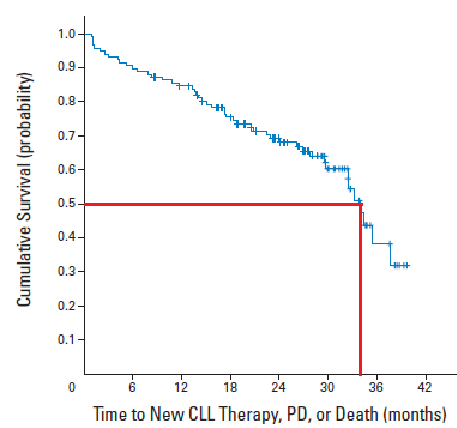
- The overall response rate was 88%, but only a measly 23% got a “CR” response. Bulk of the remissions were partial (64.9%) and stable disease in 9.4%. Bummer! Since you and I know very well that chances of a partial response or merely stable disease holding the line very long are not all that good, the low rate of CR responses is indeed a disappointment. Sure enough, as you can see in the graph below, the rate of relapse was pretty steep right from the get go. Half the patients needed to start new therapy, had progressive disease or died by about 34 months. (Follow the red lines I drew in, to see how long it took for exactly half the patients to have relapsed). If anything, the relapse rate was even steeper after that point.
- How about quality of life during and after this therapy regimen? I wish researchers would make that part of their data collection, ask folks how they rate their quality of life. But that does not happen too often. So, you and I have to do our best to guess at how life might have been for these guys. Hematological toxicities such as anemia and neutropenia take their toll. The former can cause deep fatigue, the later can precipitate infections and mandate party pooping “social distancing”. Thrombocytopenia (reduced platelet counts) increases risk of bleeding and bruising. In this context, 64% of the patients had one or more high grade (3-4) hematological toxicity. Don’t know about you, but this does not sound like a “kinder and gentler” therapy regimen to me.
- As discussed in the adverse effect section above, 11 patients died during the observation period of 27 months. I found it frankly difficult to sort out how many of these deaths were attributable to the therapy under discussion, and how many were due to unrelated causes. Write to me if you wish to read the full text article and try to figure this out for yourself.
An expert comparison
Usually, when discussing these single arm trials I have to scramble around to find a good comparison without too much researcher bias built into it. In this case, my life is made a lot easier since the JCO article above is accompanied by an editorial that does a detailed comparison. The author of the editorial is no less than Dr. Bill Wierda of M. D. Anderson, one of the lead researchers of the FCR regimen. He has a wonderful table summarizing the results of this study and comparing it to a bunch of other studies using FCR, PCR, FR and a lot of single agents as well. I have picked through his table and made the comparison much simpler for you. Here it is.

Let us put this information into proper context. The Fischer study is the present study of frontline B+R that we are discussing. The FCR study from M. D. Anderson is the pivotal study that got chemoimmunotherapy into the limelight several years ago. Dr. Wierda was closely associated with that whole effort and we can cut him some slack for perhaps feeling a bit more love towards that particular study. But the third column is the clincher of the argument. It is the “CLL 8” report of the justly famous German CLL Study Group, a very large scale study conducted at many different institutions. Heck, the present B+R study was also conducted by the same prestigious group! No one can complain about researcher bias when we compare results from the same group of researchers. It is about as credible as it gets and I think the results are pretty solid.
Looking over the chart, I am truly taken aback by the differences, especially in the percentage of complete responses and the length of remission (also called PFS, progression free survival). B+R suffers in the comparison. Choosing FCR instead of B+R seems to double the chances of getting a CR (23% versus 44%) and increasing the remission length by a year and a half, even if I take the GCLLSG results as the representative ones.
Sure, this is not an apples to apples comparison since we are not talking of a double arm trial where every other variable is held constant. But as Dr. Wierda points out, “Although the patient populations included in the trial may be different, it is difficult to conclude that the BR efficacy outcomes are consistent with FCR in the (GCLLSG) CLL-8 trial.”
It must be pointed out that incidence of grade 3-4 neutropenia was lower with B+R, compared to FCR in the GCLLSG study. But making up for this, incidence of anemia and thrombocytopenia (reduced platelets) was higher in the B+R study. Not a whole heck of a lot to point to, if you are trying to sell B+R as being kinder and gentler, compared to FCR.
One of the adverse effects that I worry about with “super” alkylating agents such as bendamustine is the long term risk of myelodysplastic syndrome and secondary acute leukemias down the road. Researchers tend to be rather coy in discussing this risk, I find. Longer term monitoring has shown even FCR has a certain percentage of patients who go on to develop myeloid cancers. Richter’s transformations and myeloid cancers are the proverbial second shoes yet to drop when considering bendamustine combinations – in the opinion of this layperson patient advocate.
Do send me a personal email if you want to read the rest of Dr. Wierda’s well reasoned and pithy editorial. I enjoyed reading it. It clarified the picture a great deal.
Editorial
Not much to add to what Dr. Wierda had to say, just tying a few loose ends to finish the job. As you can see from the author list, this is a pretty heavy hitting team of German CLL experts. Also as you would expect, majority of them had financial support from the pharmaceutical companies involved (Mundipharma, Roche), in terms of paid consultant or advisory role, or honoraria – not unexpected, that is how most clinical trials get funded these days.
So, does this important paper succeed in replacing FCR with BR as the new gold standard for chemo naive patients? We have to wait a bit more to see one-on-one comparison in terms of two arm trials, but what we have seen thus far suggests we may want to hang on to FCR for a while longer. Is BR the kinder and gentler version of FCR style chemoimmunotherapy we were hoping for? I am not sure that has been shown to be the case either, not in view of the high percentage of grade 3-4 adverse effects. Is it good to have this drug combination thoroughly tested in clinical trials? You bet. It is always good to have choices, and bendamustine combinations are important choices to have. At this stage of the game, if there is no reason to rule out FCR, would I choose BR as frontline therapy? I do not think so, the case has not been made to my satisfaction. I would stick with the “better known devil” of FCR, until and unless more positive results of BR are demonstrated in future studies.
For a change, there was a clear acknowledgement “We thank all patients and physicians for their participation in the study“. Wow. I appreciate that. We must be doing better getting our message out.


 RSS Feed
44 comments on "Bendamustine + Rituxan: better than FCR?"
Thanks for presenting information so clearly.
Why do you report on a study from 2007 (and earlier)?
Why do you not talk about (very positive) results of the 2 follow-up studies?
Afraid of “east-German” stuff?
Thanks for the info. Not sure if this is the right place to put this comment, but . . .
The point about the age of the patient is often made. However, for those out there who are older, or have older partners who have CLL, I have discovered it appears to be the overall health, not the calendar age. My husband was 69.5 when diagnosed and began the full-up FCR at 70. His doctor had no qualms about the FCR.
However, he was otherwise extremely healthy when diagnosed. Not on any medications for any conditions. Still very active outdoors with chores and golf. (A little overweight, but the blood sugar was normal.) He is starting round 5 of 6 and has really had no adverse effects. One period when I think he caught a cold from me and couldn’t shake it for a month. That spiked his fever for the only time during treatment so far, but he never had to be hospitalized. His lungs stayed clear and his blood counts looked great. His blood tests and interim CT scan after the 3rd round show excellent progress. So, even for “old geezers” over 70, the tough treatments can be tolerated and be effective if there are not other health problems.
bm003162
This study started patient recruitment in 2007. It involved a reasonably long monitoring period of 27 months. Please note the publication date of the paper I am reviewing: August 2012. It took that long to get the word out. I cannot report on what has not been published. As and when newer studies get published, I will be more than happy to review them. For example, all of us are waiting for the double arm study (also being conducted in Germany) comparing FCR versus BR.
Devil is in the details. Please be sure to read the details (such as publication date) before you jump to conclusions – and no, I have no problem with “east-German” stuff.
eehtee:
You are right, there is a huge difference between chronological age and actual physical health. In many clinical trials, they use chronological age as a general predictor of physical health – with less than total accuracy.
But there is another issue here that makes chronological age important. You see, one of the unavoidable deficits as we get older is that our bone marrow reserves become smaller, each and every year – a consequence of decreased number and function of stem cells that live there. Since chemotherapy regimens take a hit on bone marrow function, there is risk that in older patients with poor bone marrow reserves to begin with, any further decrease will put them at considerable risk. Younger patients with more stem cells and more healthy stem cells can afford to take a similar hit.
What happens when bone marrow damage puts someone beyond the minimum needed? Stem cells in the bone marrow are the only source of new blood cells such as platelets, red blood cells, neutrophils etc. Without adequate production of these cell types each and every day, to make up for the large numbers lost to wear and tear, pretty soon the patient becomes anemic, neutropenic and thromocytopenic. Pan-cytopenia is very dangerous. The only options to handle permanent pan-cytopenia is a stem cell transplant or becoming transfusion dependent for the rest of their lives. Not good solutions, either of them, especially in an older patient.
Given these results, should BR even be considered in refractory FCR patients? My wife got a partial response from FCR and now has active/progressing disease 6 months after FCR. BR is one of the salvage therapies we’re considering. BR + Ibrutinib is another.
My husband is presently receiving bendamustine and Rituxan therapy. The day prior to the B & R infusion he receives IVIG. So far he has had excellent results. I should also state that he is now 64 years old, diagnosed at age 61. For a variety of reasons he did not seek medical followup and in mid March this year became very ill and admitted to the hospital. His WBC was 360,000 and he had pneumonia. He received wonderful care and survived. He has had 3 B&R infusions so far and we are hoping next week will be the last one.
Thanks, Chaya, for the explanation on the bone marrow and age – which I should have known (knew when my husband started treatment, at least!) Thus, the bone marrow test before his doctor would decide on treatment regime and the regular interim blood tests at nadir between treatments and again before the next treatment to check on whether the platelets, red blood cells, etc are recovering between treatments – if there is ever a time they don’t, she has said we have to consider stopping or pausing. So far, so good. Red blood cells just failed to recover to normal range for the first time before the 4th treatment round (but still close to normal) and platelets were in normal again before that round. I’ve heard the most serious stories about the neutrophils problems – but so far, so good. I understand it is more of a risk over 70.
I am a 67 year old Caucasian male initially diagnosed in late 2003. Within a year I was treated with FCR plus Mitoxanthrone and achieved a complete remission which lasted until the end of 2010. This was administered by Dr Michael Keating at MDA. As the remission faded I again consulted Dr. Keating who suggested that I enroll in the Anderson clinical trial of FBR which I did receiving the first infusion in December, 2010. Two weeks later, back home in Atlanta, I lapsed into a coma which lasted 10 days. It has never been determined what caused this but I decided not to continue in the clinical trial. I should also mention that besides the CLL I am also an insulin-dependent diabetic and have been such for 55 years. I have yet to see any recognition of the possible relationship to the therapy. In the meantime I am now completing the 6th month of the NIH trial of Ibrutinib
and it has worked wonderfully for me.
I am left with a bitter taste about the lack of any serious follow-up,
or, for that matter, any follow-up regarding the possible relationship between what happened to me and the FBR triad with which I was treated.
Thanks, Chaya. I have been waiting for this article. Question: Is that a typo in the RESULTS part where it says “Ninety percent of patients with del (121q) ?
My husband was diagnosed and within a week or so we were signed up for B+R. We did not know anything at that time. I have learned a lot since then and wish we could have waited and made a more informed decision.
Thanks!
Thank you for alerting me of this information. You always play fair with the information and I commend you for your diligence. I just finished 5 of 6 cycles of FCR and during the between times I don’t spend much time thinking about or researching CLL, that said, I need to keep up with things and appreciated the email about this article. Thanks!
I have been treated 1. R/F 2. R/C did not work 3. B/R
My nodes are popping. I know we look at the whole picture but when treatment is necessary I will do what the FISH tells me.
I am now 79 and don’t know what else to do. Any suggestions. I will not give up.
Rita
Many thanks Chaya – I always give thanks after reading your articles as I feel better equipped to face what may hit me.
Right now, I have had 4 years of good remission after FCR treatment, but on my last 6-monthly review although my blood was still clear, I have a significantly enlarged lymph node in my neck. Medical opinion – chop it out and see what the pathology tells us.
Watch this space … and in the meantime, thanks again for all the good info over 4 years!
Lawrence,
Cornwall UK
rocky164:
This study is all about chemo-naive patients. Refractory patients are a whole another story. Since patients who are truly refractory after FCR (there is a difference between relapsed and refractory, as we have discussed several times before) have few good options, any new therapy regimen is good to have. Choices are better than having no choice.
rwitz18:
If at all possible, I would like you to consider one of the kinase inhibitor trials, especially PCI-32765 (ibrutinib). Easier said than done, since these trials are getting sold out very quickly.
kpettit:
Yes, I believe it is a typo in the abstract, it should have read 11q. I am basing this on the response rates quoted for each FISH deletion group in the full text article, Table 3.
Lawrence Hanney:
Why the lympho node surgery? Unless they suspect some sort of a transformation to more aggressive lymphoma / leukemia, I am not sure what the lymph node biopsy will tell them that they cannot learn from blood samples and perhaps a bone marrow biopsy. Surgical removal of a lymph node for the purpose of biopsy is rarely done for standard CLL. But all bets are off it they are looking for a transformation to more aggressive cancer.
jackebenton:
I am sorry they did such a poor job of followup after your FBR disaster.
Frankly, I am not a big fan of FBR. BR is plenty heavy duty, do we really need to add fludarabine on top of it? Sometimes I think MDAnderson overdoes the Texas thing just a bit too much. I am glad the NIH trial is working well for you. It is a good team, I hear rave reviews about them from everyone I send there.
Thanks, Chaya, for an informative article on recent developments. It’s gratifying to see the dedication of all involved on our behalf in the battle against this disease. I always feel encouraged after reading your articles, even if the particular topic is not a great step forward – sometimes we have to eliminate what doesn’t work so well to end up with the winners.
Regards, Rick
russell haag I was diagnosed with CLL in 2008 and watched a waited until summer of 2011 when I started B and R infusions. I am a 17p deletion and obtained a complete response with B & R. Minumal side effects, life is pretty much back to normal. Blood is normal now, WBC is in the 4,000 to 5,000 range.
Dear Chaya, I just finished B/R for 4 months after my cll acted up after 2yrs from it’s discovery at 65 yrs old. My Spleen swelled along with neck Lymph nodes and nodes in my back. All of them shrunk very fast and my PET scan showed good remission. WE are back to watch and wait. After reading you article on FCR vs B/R, I wonder if I would have been better off with FCR especially with the long term results? I guess I will have to wait for the double Arm Trial results to see. I must say, the B/R was great as far as NO side effects. Chemo went well and MY blood numbers never fell out of the NORMAL ranges.
Thanks, Chaya,
I will keep it with me at my oncologist’s office.
Many, many Blessings.
Rita
ROBERTO
Thanks Chaya for this update.I opted for B+R as an initial treatment
after 8 years of WW.I am 76 and have all the positive prognostic indicators plus good physical age-related condition and no other health issues.
I had neutropenic fever and a severe body rash after 2 sessions.this was followed by a series of emergency hospital visits because of extreme
temperature levels.The third session produced the same results and I stopped the treatment.I opted for B+R because it was considered to be a less toxic option and I was concerned that, given my age,I would not be able to tolerate FCR.
M y blood figures after 3 sessions are extremely good and 3 months after my last session I will have afurther check today.
My take on my experience is that B+R would have worked for me,had I been able to cope with the side effects.
This is a shot of reality to the heart! I finished the six month front line BR regimen in June. I am now on a two month “maintenance” program of Rituxin only (first infusion Sept 4). The 10 x 10cm mass has been reduced to 2 cm, which by all accounts, is something I can live with for a long time. If that is the only consideration.
I’m 68. The side effects were almost nil. Almost. There are times when I wonder why I’m doing this, I feel so well. More often there are times when I can’t get enough rest.
Well, I’m no longer “naive” about infusion!
BTW, when the 30th day passed in July without an infusion, my body reacted oddly. Like it was going into withdrawal!
Chaya, your site has been my main source of information since I was told I have CLL. Our daughter in law actually found it. When I would ask my doctor a question that I had because of reading this site, his answer almost always agreed with your conclusions. That has always given me and my wife great confidence in your work and in my oncology department during this whole ordeal.
Thanks.
Bill
Hallo Chaya,
I can read English, but don`t write. Please excuse me that I continue to write in German :
ich lese seit vielen Jahren hier mit, Cll-Topics ist eine tolle Seite, vielen Dank dafür!
Seit 1996 habe ich CLL, von Anfang an im höchsten Stadium (IV Rai). Bedingt durch eine riesige Milz (Hyperspleniesyndrom) habe ich wenige Thrombozyten (meist zwischen 30 und 50 Tsd.)Die ganzen Jahre über habe ich mit Dexamethasonstößen ein “stable Desease” erreicht. Zusätzlich substituiere ich seit fast 13 Jahren Gluboline regelmäßig wöchentlich in Selbstbehandlung. 1998 brachten Leukeran/Dexamethason Therapien wenig Erfolg. 2006 hatte ich 5 Rituxan Monotherapien(zur reduzierung der Milz), auch mit wenig Erfolg. Obwohl mir bereits 1996 eine Transplantation vorgeschlagen wurde, habe ich mich entschieden lediglich die jeweils “sanfteste” Therapie zu machen und habe immerhin nun 16 Jahre bei guter Gesundheit überlebt. Es gab in diesen Jahren zwei ernstere Zwischenfälle, einmal (1999) eine Thrombopenie mit nur noch 1.000 Thrombos, da waren sehr viele Thrombozytenkonzentrate nötig und einmal (2001) eine Pneumonie durch Pilze (Candida albicans).
Bendamustin/Rituximab wird hier in Südwestdeutschland seit vielen Jahren verbreitet – auch bei den anderen Lymphomarten eingesetzt. FCR wird eher selten eingesetzt. Ich bin Gründer und Leiter einer Selbsthilfegruppe. In dieser Gruppe haben drei Patienten allerdings mit anderen Lymphomen (Mantelzelllymphom/follikuläres Lymphom)B/R erhalten, zwei dieser Patienten sind schon seit mehr als 6 Jahren krankheitsfrei. Ich selbst und zwei andere Mitglieder mit Cll machen zur Zeit eine B/R – Therapie.
Da Kortison nicht mehr richtig funktionierte habe ich mich für B/R entschieden. Nach zwei Zyklen ist die riesige Milz um etwa ein Drittel kleiner geworden. Den dritten Zyklus hatte ich vor zwei Wochen und der letzte Zyklus ist dann in zwei Wochen. Mehr als 4 Zyklen ist nicht geplant. Erwartungsgemäß sind die Leukos aktuell zu niedrig, aber noch im ungefährlichen Bereich, der HB ist normal und die Thrombos sind bereits von 26 Tsd. auf 77 Tsd. gestiegen. Ich bin gespannt wie es weiter geht….
Chaya, nochmals vielen Dank für die tolle Seite, ich erhalte hier viele Informationen die ich die Selbsthilfegruppe weitergeben kann. Die Artikel über die Kinasehemmer habe ich für die deutsche Website Leukaemie-online übersetzt.
Good morning Chaya,
Great coverage again. After 15 years of W&W and then going from stage 0 to stage 2 in less than a year. My local hem/onc wants me to start chemo, but I believe she is treating the numbers (not me). 13 years ago I went to Kipps for his opinion which was of course W&W. We have no experts here in Atlanta or nearby.
As I am age 70 and chemo naive, I went for the PCI trial at NIH and “flunked” the testing…too healthy according to the trial requirements. The doctors told me that they remembered my name because I was the very first phone call requesting admittance but the first-come-fist-served trick didn’t apply. ;o)
From everything I have read here and gleaned on my own, I am going to try to wait it out for something better than FCR and BR and other Alky/Purine combos. As long as I am playing tennis 3x per week, taking walks, not succumbing to my grandkid’s viruses, and feeling generally healthy, I will read (what I want to read) into your words, Chaya, and hope for something better down the line.
I am sending you privately MY translation of the German above. Hope it helps and makes sense.
Thanks as always for your ‘translation’ from meditalk! In the comparison table in your article, why is there such a difference in results between the two FCR MD Anderson and GCLLSG trials when they look so similar? and what is Phase 1 and phase 11?
Is it possible to post the German translation? – I’m all intrigued now!
Best
Molly
Chaya, I usually read your information related to clinical trials with great interest, but even more so now, as I just began treatment (after 6+ years of W&W) in a clinical trial at Mayo Clinic in Rochester, MN. This trial is designed “to assess the treatment-free survival rate at 18 months using pentostatin, cyclophosphamide, and ofatumumab induction therapy followed by ofatumumab consolidation in patients with previously untreated CLL.” The drug under study is ofatumumab, and its use in combination with the other drugs. According to my Mayo hematologist (who I’ve been seeing for over 5 years), the initial results have been very promising. This is a Phase II trial being offered at all three Mayo locations, so it might be worth looking into for “franc” in Atlanta (not too far from Jacksonville). Mayo is recruiting now for it. A link to the Mayo description of the trial is at: http://clinicaltrials.mayo.edu/clinicaltrialdetails.cfm?trial_id=101307&location=4&theme_id=3&letter=l&eKeyword=none
Just to clarify one point in my comment above, the Mayo trial has more purposes than just evaluating a survival rate of 18 months–it is to study the overall effectiveness of the PCO combination. The study has a 5-year duration, with the treatment occurring in an induction phase of once per week every 3 weeks for 6 cycles, an 84 day break, and then a consolidation phase with treatment using only ofatumamab once a week every 4 weeks for 6 cycles. This is followed by regular quarterly visits to Mayo.
Chaya,
The two comparison B+R/FCR charts in your article show FCR as by far the better option but there are other side effects to FCR that need addressing.
This was posted on our British CLL support newsletter written by Prof Terry Hamblin as part of his When to Treat article:
‘Because FCR causes profound immunodeficiency for a long time and because there is a worry that it might increase the risk of secondary cancers including myelodysplastic syndrome and Richters syndrome, some are reluctant to use it as first line treatment.
What are your thoughts on this?
Molly Fletcher:
There is no doubt FCR has a significant adverse effect profile, including immunodeficiency, blood toxicity. But so does B+R. If you go back and read our review, we do discuss the risk of hematological toxicity (anemia, thrombocytopenia and neutropenia) seen in this B+R trial. You can get more details by reading the original article itself. The Wierda editorial we reference goes into more details comparing the blood toxicity of the two regimens.
Which therapy has worse hematological toxicity? That is hard to nail down without a truly head-to-head comparison of the two regimens, in a double arm trial. There is a trial presently underway in Germany which does exactly that. When it is complete and the results are reported, we will have a better understanding of this direct comparison between FCR and BR.
For now, it boils down to this: neither regimen is entirely without merit, neither is a perfect cure, both have risks and rewards associated with them. Individual patients and their doctors have to make therapy decisions based on less than 100% accurate and complete information. That is what makes CLL such a complex disease, especially as new drugs and regimens are being rolled out. Complexity is tough to deal with. But at the same time, there is no question that we are better off having more choices rather than fewer choices.
To answer your previous question, the difference between the MDA and GCLLSG clinical trial results for FCR are due to a number of factors. The inclusion criteria were slightly different for the two trials, resulting in slightly different patient cohorts, for starters. I am also convinced there is some researcher bias in the single institution study (the one done at MDA), and for that reason the results from the multi-center GCLLSG study are more credible.
I have never experienced FCR but I did have FR in 2002 and again in 2007. Each time I had prophylactic drugs (allupurinol, Bactrim, acyclovir) plus Neulasta to prevent neutropenia. I had few bad side effects with this regimen. In 2009 I had BR which caused more nausea but that was controlled by generic Zofran. Neither of these regimens are a walk in the park. In 2011 I had a Richter’s Transformation. This is purely anecdotal and is in no way clearly a result of the BR regimen which preceded it. In 2002 FCR was not the gold standard and FR worked well for me. The track record for BR is not as established as that for FCR so it is not clear to me why BR would be used in the front line situation. Once you stop responding to Fludara then Bendamustine seems a reasonable alternative. Of course in 5 years or so there will be other less toxic options available but until then we have to choose wisely among the current options.
I am grateful for your advocacy, and ability to take medical jargon and
make it understandable to the laymen. Perhaps the best advice I have
recieved since Dx is from your CLL primer, “Buyer Beware”. When one is
tired and thirsty, floating in the middle of the ocean, it is tempting
to drink the salt water.
I am not implying that B+R is salt water, no “regimen is entirely
without merit, {none are} a perfect cure”. I am however a little bit
thirsty.
Chaya,
Thanks for the analysis re. B plus R. I have been wondering and hoping this therapy would prove effective with less side effects than
FCR. Does not really look much better at this point. I am just hoping the newer therapies that are not chemo like the tyrosine kinase inhibitors now in trial become readily available sometime soon with out delays etc.
Chris R.
Thanks for another excellent article, Chaya. Thank you also for hosting the monthly meetings at your house. I know they are very helpful, even comforting, to the attendees.
Carter
Thank you Chaya for all your work. A few comments about the B-R study, and on reading medical publications in general.
The meaning of words
Sometimes words represent real actions or things. For example the words male, age, bendamustine, have the same meaning whoever you are (doctor, nurse, patient) and wherever you are (United States or Nepal).
Sometimes words are simply numerical codes, and are not meant to be used in conversation. For example: grade 5 toxicity meaning death is simply a numerical code to be used in a database to indicate that a patient has died. If a patient dies, the number 5 will be entered in the database. Why not write “death” in the database instead? Simply because if someone misspells the word death (a typo) (deth, deat, deeth), the patient would be misclassified as still being alive. It is less likely that someone would mistype the number “5” (and it is easier to double check for typos when numbers are used). The expression grade 5 toxicity is not a sign that CLL oncologists are crass uncaring insensitive and vulgar; it is just a code. In 30 years as a physician in a subspecialty of oncology, I have never heard someone say “Mr X has a grade 5 toxicity” or “In my study, there were 32 grade 5 toxicities”, and anyone who did would be the laughing stock of his colleagues and audience.
Sometimes words do not represent actions, things or numerical codes. They are simply the result of a negotiated agreement between 2 parties (which can be renegotiated at any time). This concept is both simple to understand and of the upmost importance when you are reading a medical publication. Take a simple example: “free range chicken”. Some people will imagine chickens running around in a field all day. Some poultry farmers say that if they open the barn door 5 minutes a week to allow the chicken to go for a walk (if the chicken chooses to do so), it is a “free range chicken”. When you go to the grocery store and it is written “free range chicken”, what does it mean? The answer is that the meaning (how long chickens should be outside, etc) is the result of a negotiated agreement between the US agriculture department and the poultry farming lobby. The definition can and will change over the year as it is “renegotiated”. Now take the expression “grade 3 hematologic toxicity” (which can be applied to hemoglobin, white cells and platelets). What does it mean? The answer is that the term “hematologic toxicity” does not represent reality; it is the result of a heated negotiation at the National Cancer Institute, and the definition changes over time. Indeed, during the FCR study, version 2 criteria were used; during the B-R study, version 3 criteria were used. For example, a patient with 20,000 platelets would have been classified as grade 3 during the FCR study and grade 4 during the B-R study. This is why the authors state: “The incidence of both thrombocytopenia (grade 3 to 4, 22.2%) and anemia (grade 3 to 4, 19.7%) appears to be higher compared with the reported numbers in the FCR trial because different versions of the NCI-CTC were used for grading hematologic toxicities (version 3.0 for this trial, version 2.0 for CLL8). When applying CTC version 2.0, grade 3 to 4 thrombocytopenia occurred in 11.5% of the patients, and grade 3 anemia occurred in 4.3% of the patients”.
Patient populations. If you want to compare 2 different treatments, you must do everything to use comparable patient populations to give each treatment an equal chance. Imagine a tug of war; on one side 100 CLL patients who were treated with FCR, and on the other 100 CLL patients treated with B-R. The outcome will determine which treatment results in the most fit (strongest) patients. The following day, you read the newspaper: “FCR wins by a large margin, after only a few minutes”. The conclusion is obvious: FCR is better ! After reading the B-R publication (lower response rates, shorter event free survival), you would draw the same conclusion: any idiot would conclude that FCR is better. Now imagine that instead of reading the outcome of the tug of war, you actually witnessed the event, sitting on a park bench, and observed that whereas the FCR group tended to be young and mobile, there were many frail older contestants wheelchair bound in the B-R group. You would cry foul ! It’s absurd ! B-R lost because so many of its contestants are in poor shape to begin with, irrespective of treatment. That’s precisely the problem when you compare the FCR and B-R studies: patients with renal failure comprised one third (!) of the B-R group, , but were excluded from the FCR group. Patients over 70 account for one quarter of the B-R group, and only 10% of the FCR group. Patients in the B-R group had more advanced disease to start with (46% vs 31%). It is therefore a very difficult to draw conclusions. I am still working on it, spending hours rereading the manuscript, pencil and paper in hand.
Missing variables does not mean treatment failure. The complete response (CR) rate after B-R is disappointing (23%) but difficult to interpret because a a significant number of patients with a clinical complete response could not be classified as complete response simply because they did not show up for the follow-up bone marrow biopsy or XRays (14 patients) or bone marrow biopsy alone (11 patients). A total of 28 patients out of 117 had a complete clinical response but were classified as “incomplete” because they did not show up for a follow-up test. Remember what I said about words. The term complete response is the result of a negotiation between CLL investigators. At the present time, this includes a bone marrow biopsy. If the patient has a complete response but does not show up for the test, he is classified as incomplete response.
Mortality: in the B-R study, 11 patients died. Death was unrelated to treatment in 6 patients – so forget about them. I suspect that apart from the 3 Richter mentioned in the publication, others were from fatal heart attacks and strokes, considering that the population was older and there were quite a number of high risk patients with renal failure. You are left with 5 patients, of which one died from liver failure after a suicide attempt (I would call it a successful suicide attempt ie a suicide). You are left with 4 ‘involuntary” (non suicide) treatment related deaths, all from infection, quite a far cry from the 11 deaths we started with.
So, how would we turn complex numerical data about mortality into practical suggestions?
With B-R death due to treatment is rare (4/117= 2.56%), so don’t worry about it.
The death rate is very small but not zero. If you are going to undergo B-R (or FCR) treatment, have some consideration for your family: make an effort to have all your papers and finances in order, just in case things take a turn for the worst.
The few deaths that occurred were all from infection. If in the course of treatment, you develop signs of infection (fever, etc), don’t delay, go to the hospital; don’t wait for the following day or for Monday if it is the weekend. I would even go further and suggest that you have a pre-chemo plan: if you get signs of infection: make sure that you have a list of items to bring so you can pack a small suitcase quickly. Decide how you would get to the hospital if you have to go during the day, evening or night or weekends.
Myelodysplatic syndromes, Richter, secondary leukemias and cancers, etc. My understanding is that oncologists hope that Bendamustine will be LESS toxic in the long term (to the bone marrow and risk of secondary cancers), not the other way around. The hope (still to be proven) that bendamustine will be LESS dangerous than the combination of fludarabine and cyclophosphamide. I have not heard concerns that Bendamustine would be more toxic (I may be wrong but perhaps Chaya could ask her sources).
Chaya, thanks for this informative review. (As I’ve said before, you have the knack of clarifying the complex.)
I would like to relate my experience with B+R chemoimmunotherapy for CLL. Although my B+R treatment is salvage therapy following relapse, my original chemo was single agent bendamustine which my make it legitimate for this discussion.
I’m a 78 year old CLL survivor—DX Jan. 2003—who received 6 rounds of single agent bendamustine in the 2nd half of 2008 and remained in remission for 4 years. (As I have reported earlier on this site, I had absolutely no side effects during the treatments.) In late winter 2012 my WBC began the expected rise. Thus, in April 2012 my Dr. started me on a regime of B+R at the Cleveland Clinic. (Ben—70 mg/m^2 on day 1 and 2; Rituxan—500 mg/m^2 on day 2) After 5 monthly cycles (one more to go) my CBC results are excellent. Again I have had essentially no side effects—save a fever spike after day 1, Rounds 1 & 2 only. I continue to be active—regular health club routine 3 times per week—and have an excellent quality of life. Yes, I’m one of the lucky ones as I have no other medical issues.
This last comment is only a digression, Chaya. As a fellow chemist maybe you can relate to my reasoning for going with Bendamustine—in a field of several near equivalent options—for my Chemo agent. My working life involved the pursuit of chemical compounds for an industrial process. The highest goal of this work was to discover dual-function compounds, i.e. materials that would perform an intended function, then leave a useful (2nd function) residue. Although I would agree that the ‘dual chemistry’ of Bendamustine may not be operative in its medical function—only a gleam in a scientist’s eye—it is a noble pursuit that got my attention.
Keep up the good work, Chaya.
Al
Wadsworth, OH
Thanks for your comments Chaya. YES I think they suspected Richter’s Transformation, I had the node out under a local anaesthetic, and the pathology confirmed that it’s straight CLL coming back. NOT Richter’s.
So I’m on a second run at FCR to try and give me another remission. I was very grateful for my 4 years, and if I get anything like that again I shall be very grateful.
In the meantime, your article helped me explain Bendamustine to my partner, which was very useful.Solid knowledge helps her not to worry so much.
So as usual, a BIG THANK YOU, Chaya, and I’ll look forward to reading your future articles.
Lawrence
I have been following this site for quite a while. It has been a valuable insite in the understanding of CLL since my husband’s diagnosis. Today is the first day I have had the courage to log in and ask questions.
My husband was diagnosed with CLL in 2007 at the age of 58 (the same year as our grandson of 3-1/2 yrs. with ALL). He has received 3 round of Rituxan from 2010 to 2012 along with steriods to help with the low platlets. He had pneumonia Dec. of 2011 and Dec.2012. They will start IVIG Jan. 9th (once a month) for 3 months to boost the immune system and then the plan is to take Bendamunstine and Rituxan Therapy in March. He has diabetes but takes Metformin to control except when he is doing treatment.
The Rituxan has been a well-tolerated treatment but the Ritxuan and BR has me terrified. I appreciate everyone’s experiences which will give me confidence as a caregiver and a breast cancer survivor to go forward to help my husband.
Chaya, thank you for all your work. You have made my life easier by being informed when we visit the oncologist. Knowledge is power over your life. When you loose your power, life is not as easy. Please have a well deserved rest to rejuvenate.
Nancy Rose
Hi,
Most of the treatments for CLL with BR say they were used in untreated patients. Since Rituxan is part of the BR treatment, it is still a treatment…so would the BR treatment work as well as some of the studies. Thanks!
Nancy Rose
I completed my first treatment of B&R two weeks ago.
I felt that the Rituxin was harder to tolerate. I received Rituxin and Bendamustine on Day 1. About an hour into the Bendamustine, my blood pressure dropped rapidly, nausea, chills, but they took me off for 30m and tried again, and had no more effects. Came home zonked from the Benadryl but otherwise okay. The next day, Bendamustine alone was easy, with no symptoms, worked through the infusion. Following day, D3, slight nausea even with anti-nausea meds, no appetite, raging thirst way beyond simply being well-hydrated. By D4, no appetite (a novel and welcome experience for me) and very faint nausea but feeling good. Swam about a mile over three days (usually swim .5m every other day). By D7, I would not be able to tell that I’d had chemo from body sensations. Stopped taking allipurinol and all feelings of nausea disappeared completely.
First cbc today, D14, and wbc down from 128K to 4, everything normal. My swollen lymph nodes disappeared so far as I could tell.
Will take 2nd round in a week. Will see if things remain this bearable.
To janeb you will be in my thoughts and prayers as you go through the 2nd round of treatments. Thank you for sharing what you went through in the first round.
I don’t write this to get pity (well, honestly, I want my mother and to run away) but I tell myself it’s for the history.
I had made the mistake of thinking if the first round was easy, the second round would be easier still. That’s what they told me.
Well, the second round was rougher. I was in great shape going in. About 7pm malaria-like shakes hit me and kept going all night. Hardest chills I ever had. I finally had the brains to take a long hot shower which helped me a bit, but still moved between fevers and chills all night. Tylenol helped a bit, but not too much. Slept now and then but mostly just enduring. Still sore from the hard spasms. Probably toned my thighs. Very thirsty again. Thirst then nausea, then thirst again. I was trying to remember the food they create for dysentary patients… Must look it up.
The next day, felt very ill, looked puffy and gray, but went in for treatment, staff was sympathetic, sweet, but treatment must go on. I could hardly be bothered to open my eyes for more than a few minutes. Could not eat except by pure maternal deep programming (You will eat those green beans, Jane Ann…) No more chills or just a few sporadic ones. Yawns and stretches tended to turn into something not quite normal, a bit spasmodic, but could retch for the cameras at will.
The following day, pretty bad, stayed in bed or recliner, again strong feeling of sickness, dry heaves at the mere thought of food, although I made myself eat. My favorite foods like yoghurt? Forget it. Can’t describe what it smelled like to me. Reminds me when I had morning sickness. Nausea and heightened sense of small are linked in me. I don’t mind the extra sense of smell, and I know that nauseau can be much worse than I’m experiencing. Food poisoning I had once was much worse because one literally couldn’t stop retching. Very much like morning sickness.
Today, day four, woke up and found I could keep my eyes open all day, but still too zoned to be able to do real paid work. Have not told my vendor (I am a contractor) because I strongly believe they would not be sympathetic, as in not sending work my way when I need it most. Fortunately, one project got pushed out a week (phew) and I shared my situation with the customer with whom I actually work who never talks to my vendor.
Honestly, the thought that this will get even worse in the next round frightens me a little. I like to think of myself as this very bold forceful woman. Turns out, I’d simply not been tested. Yuck.
I had hoped by now, D6, that things would be better but they’re actually worse. Covered from head to with red rash, almost no bare skin except face. Itchy in places, palms especially.
And my nausea has increased not lessened. Can’t tolerate food or keep it down.
I hope things are better by now and that you can tolerate some food. Are you able to keep down liquids? I can see you are a strong person…please know that I care and you are in my daily prayers.
Hello, I am new here. I have been reading and reading all on this website for the last 2 years. My husband was diagnosed with CLL in 2003. Had FCR late 2003 CR for 4.5 yrs. Next, maintenance with Rituxin 4m. Had B&R which ended in Jan 2011. It took him 6 months to recover from the terrible neuropathy it gave him, he only got a PR out of it. Now, he has totally relapsed. He is 62 years old.
Sorry, that would have been Jan 2012 he had his last session of Rituxin and Treanda. He has relapsed after 14 months. His oncologist told him that B&R would be gentle on him and that there were very few side effects. Boy was he wrong. Rigors, nausea,neuropathy, terrible rash that had to be treated with photo therapy. I didn’t think he was going to survive it. He breezed right through FCR, did it on weekends and went to work on Tuesdays. We found out yesterday that his WBC was up to 13K and numberous enlarged lympth nodes on his neck and groin. The B&R never did get all his lymph nodes totally down, that is why the doctor told us it was a Partial Remission. I don’t know what is next, he has another appt. the fist week in April. I do know that he will never have B&R again.
janeb, I hope things are going better for you by now. I hope so. I very much would like to hear how the rest of your experience with B&R went.
My doctor wanted me on B&R, but I refused and managed to get into a clinical trial involving GA101 mono-therapy instead. It seems to have worked pretty well for me; not a complete remission but a “pretty good partial remission” was the description the doc used.
I had a few side effects with the treatment; nausea, up-chucking, low grade fever, but nothing too terrible to bear. I feel much better than I did before and I am so glad those lumps on my neck and spleen are so very much smaller than they were. I’m trying to hang in there and stay as well as I can until some other things that are in the pipeline become available.
Best, and I keep you in my prayers.
BJ
Leave a Comment